


Quite often the same questions come up again and again in the various Facebook pages and groups about Extreme Day Trips. People are interested in trying but don’t know how to go about it. Rather than repeating myself, I thought I’d put together a guide for people looking to dip their toes into the water.
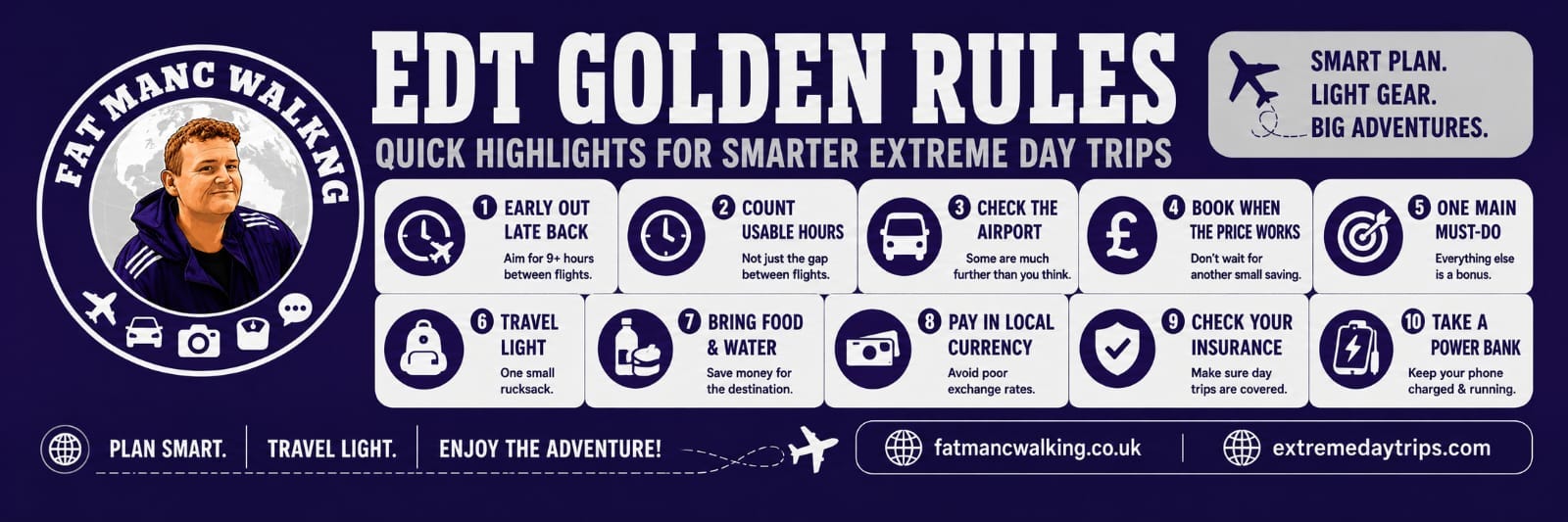
This article is going to be a more detailed version, but if you want a quick guide, I’ve produced a shorter, more visual guide too, as not everyone likes reading!

You can download the guide here for free, please drop a comment on this page to let me know if you find it useful and also if you have any other tips of your own!
How to find Extreme Day Trips
So, you’ve decided you want to try an extreme day trip, how do you find flights that work so you can fly out somewhere and come back on the same day? preferably as cheaply as possible
There are two main tools I use to do this, plus the airlines own websites and apps.
The first is the excellent website and app www.extremedaytrips.com
ExtremeDayTrips.com
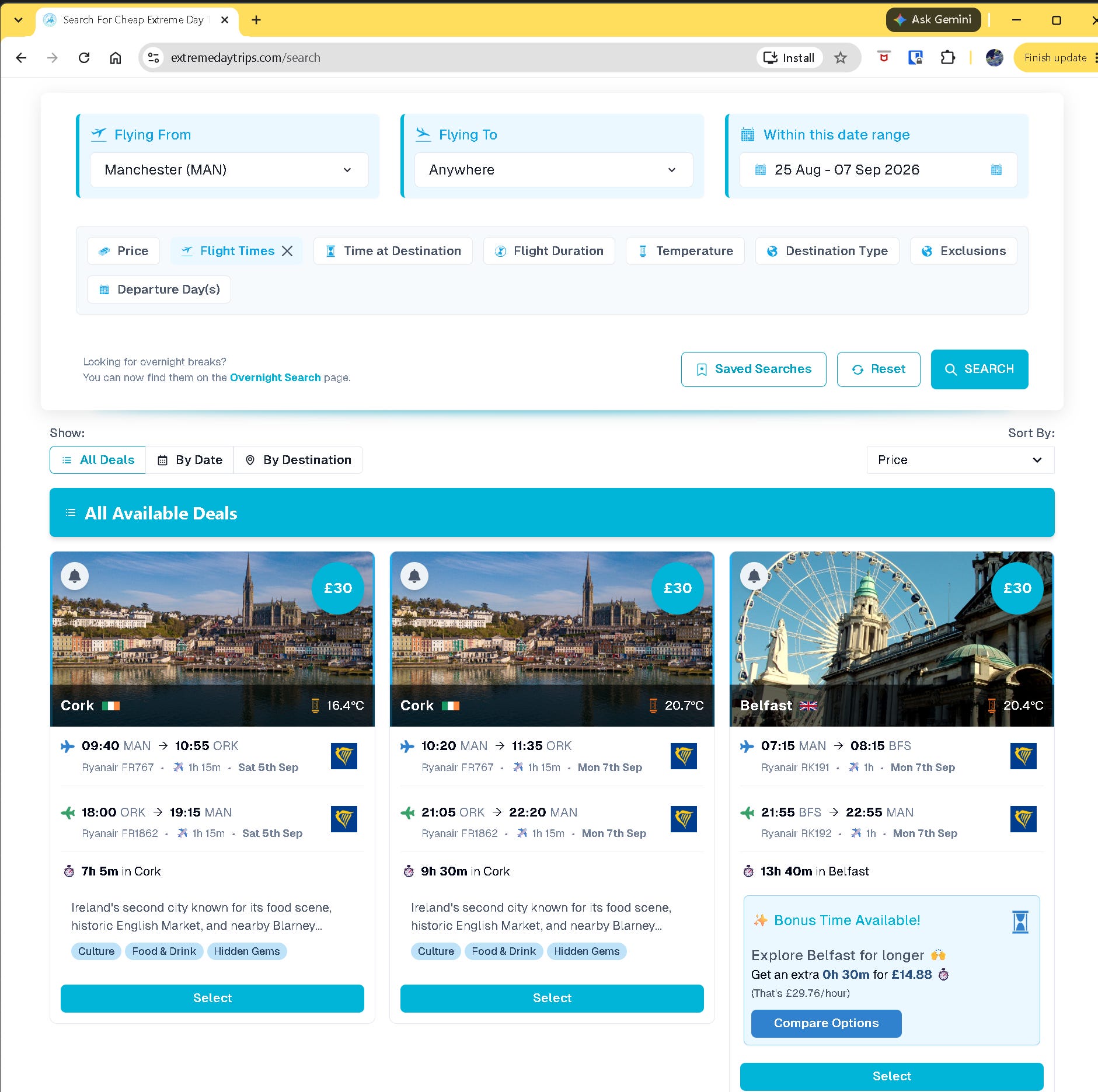
ExtremeDayTrips.com is a search engine that will help you find flights from UK airports to anywhere, where the flight out and back is on the same day, so exactly what we are looking for. Choose you outbound airport, leave the destination as anywhere and hit search. It will find you flights leaving in the next two weeks, ordered by cheapest first.
How to filter
The cheapest flights are often to Ireland, but if you want to go further afield, you can use the Exclusions button to filter them out.

If you’re looking for a specific destination, you can search for that too.
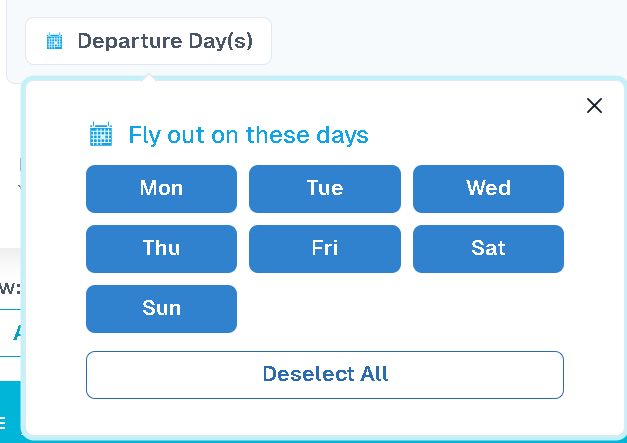
Another option is to choose your departure days. Maybe you’re only free at weekends? Don’t worry, the site has got you covered.
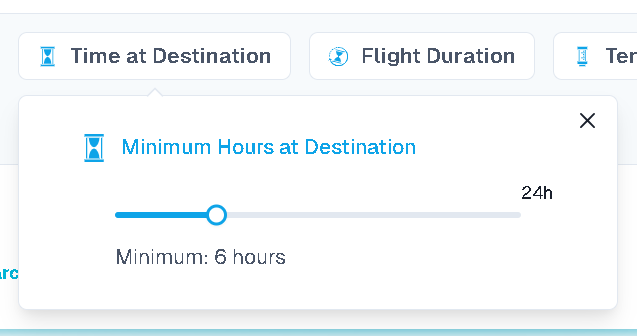
The other useful filter I use regularly is to set the minimum Time at Destination
When you see a deal you like, click Select and it will give you the links to book directly with the airline
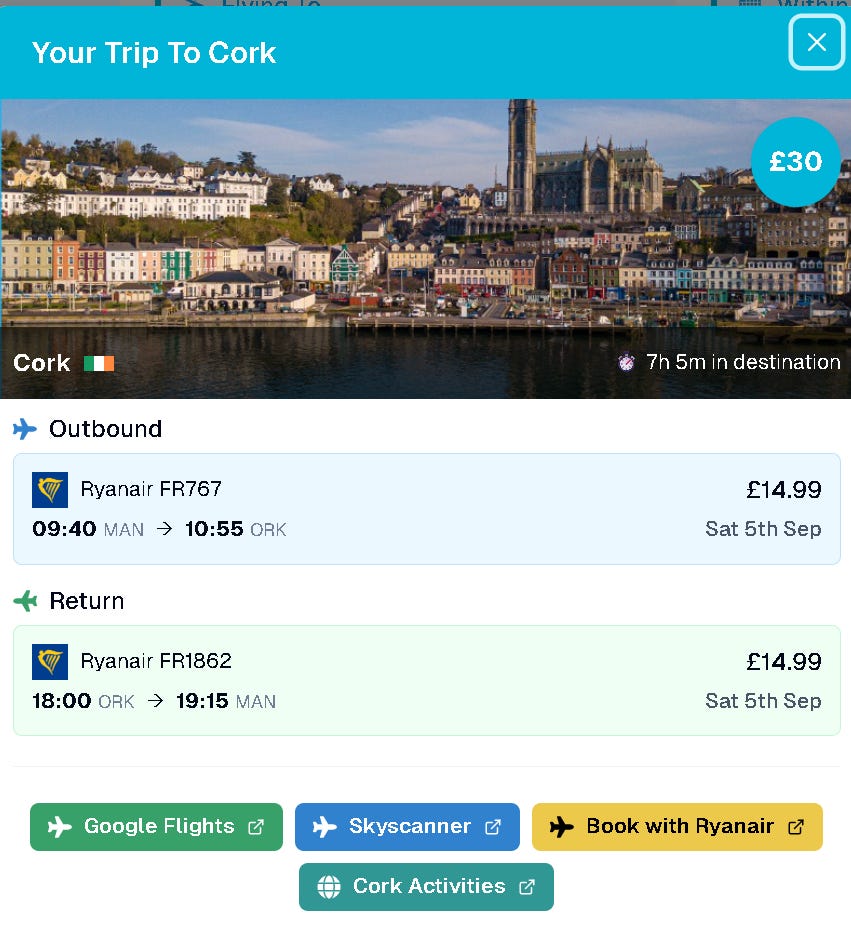
You cannot book flights directly through extremedaytrips.com. Budget airlines like Ryanair only let you book directly through their own website and app, cutting out the middle man to keep your flights cheaper.
Also note that airline prices are dynamic and change incredibly quickly. What the airlines do is they allocate seat prices into buckets, with some tickets available at the cheapest price, then incremental prices for each bucket. They sell the cheapest buckets first so if someone has booked the last seat in one bucket before you reserve your seat then the price can change. This is why I highly recommend booking as soon as you’ve decided you want to do the trip, otherwise the price may go up so use the prices as a guideline, not a promise.
What if I want to book more than two weeks out
To search further into the future, and to get emails with early access premium flight options, you can pay to use the premium version. At the time of writing it costs £37.00 a year for the premium version, allowing you to search for 1 month for an anywhere search or £49 a year for the premium plan plan, that lets you search for prices upto 6 months in advanced.
Is it worth paying for Premium?
I would say that if you’re just thinking of trying an EDT for the first time, just use the free two week tool and I’ll share with you a little trick, but if you are like me and addicted to Extreme Day Trips and want to do several a year, then it’s absolutely worth using the premium plus service.
My trick
The reality is that airline tickets get more expensive the closer to the departure date. There are sometimes deals where the prices have been dropped if the flight is not full, but the sweet spot for most of the best deals is 8-12 weeks in advanced, but the free version of the site only gives you a 2 week search engine.
Here is what I did when dipping my toe in.
Search for flight combinations on extremedaytrips.com
Go to the airline website
Look for the same flights 8-12 weeks out
Why this works
Airlines usually fly the same services all season so if you’re searching for flights, that Wednesday return trip to Paris is likely to run the same schedule every week, but there’s a higher chance it will be a cheaper fare for the flight 12 weeks away.
In my opinion, the hardest part of finding EDTs is finding a combination of flights that work where you can get to and from the same destination on the same day and have a good amount of time at your destination. ExtremeDayTrips.com makes that bit really easy.
SkyScanner.net
Sky Scanner is another service that makes it easy to find flights. You pick your start airport, set the destination to everywhere and you can choose the same date for depart and return and click Search.
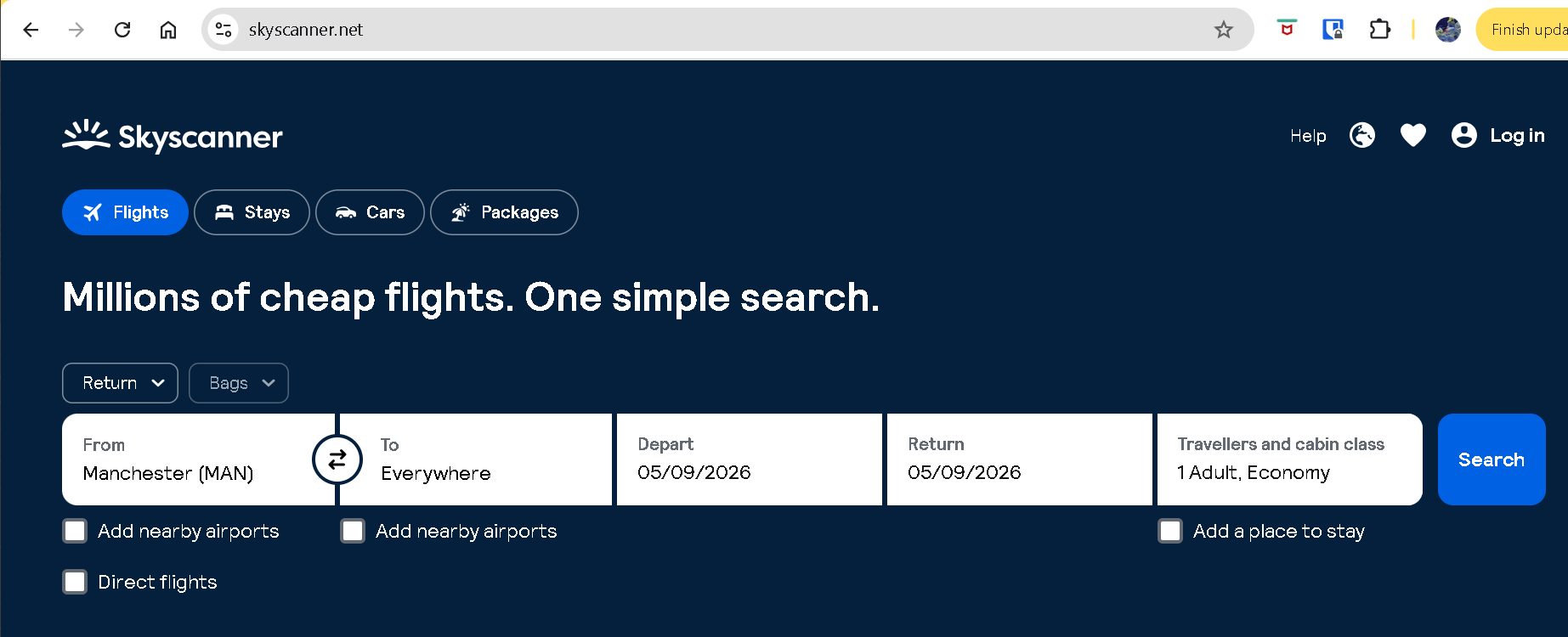
You can then see a list with prices by country and drill down.
Another option is to choose the flexible dates option, which will show you when the cheapest flights are
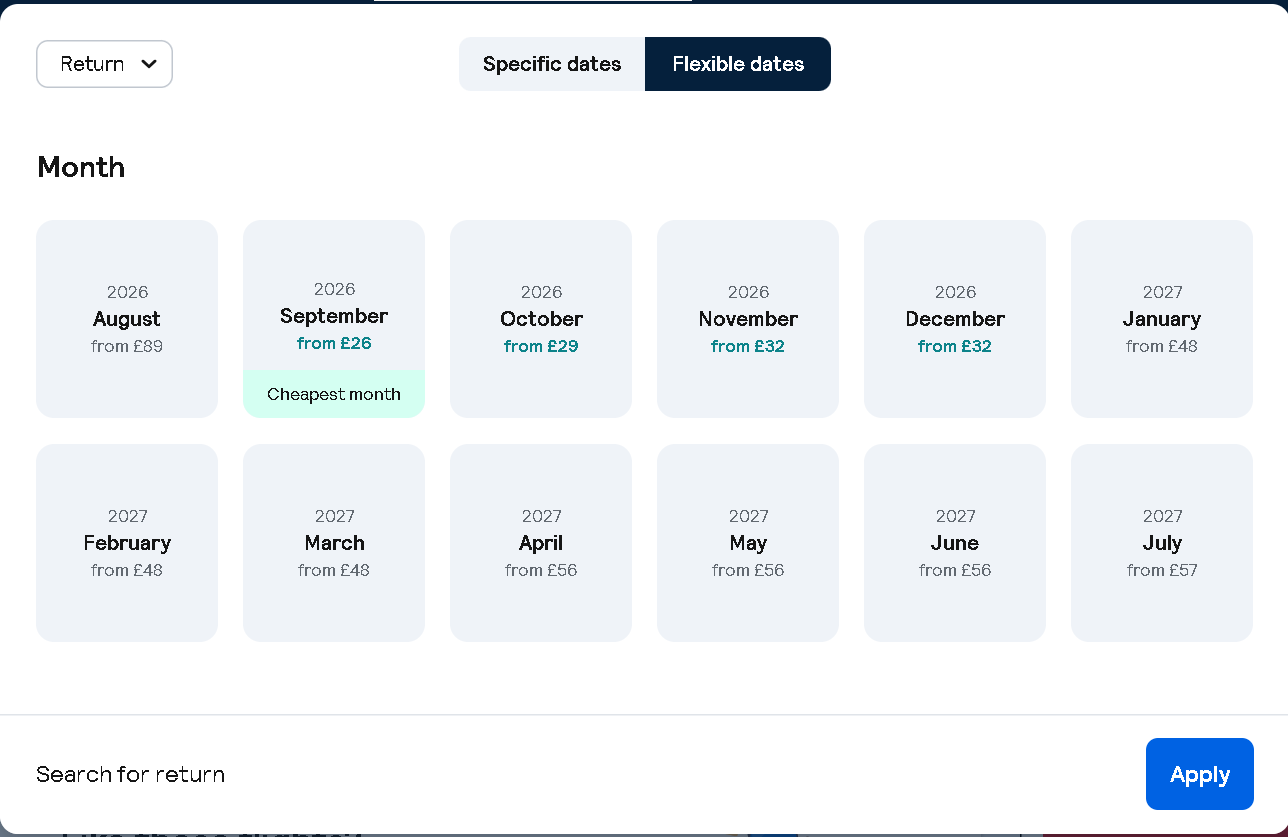
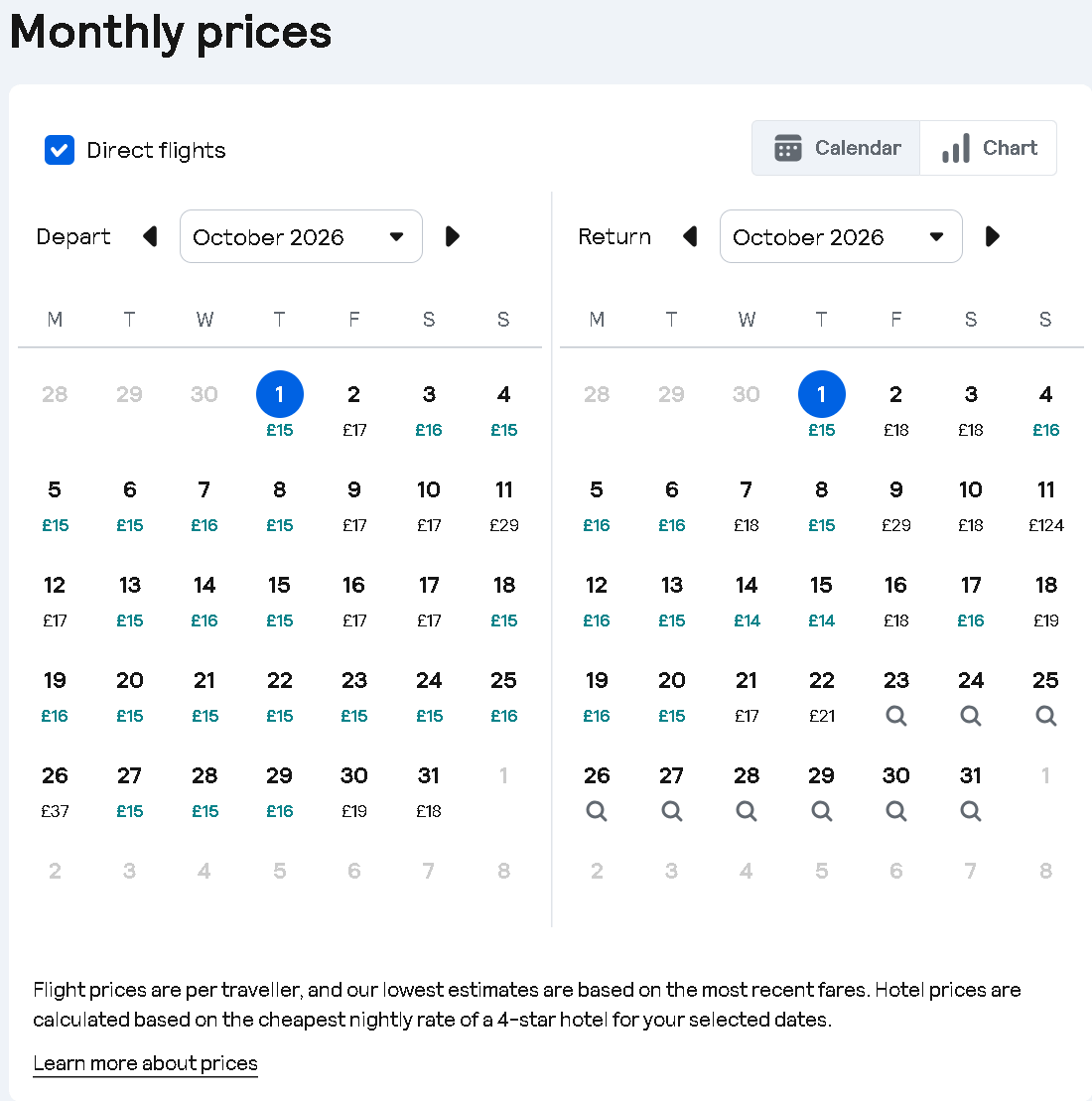
Click on the same date in the calendar for Depart and return then click Find flights
SkyScanner is a great tool and I do use it sometimes but it’s weakness is there’s no filter to look for flights on the same day, so you have to just try combinations and you only find out if the flights are suitable for an extreme day trip after drilling down. There’s no point finding a really cheap flight out if the return trip is only a few hours later.
You can use the departure time filter for each flight but you have to drill down at least two levels first to do that so it’s more time consuming than using extremedaytrips.com, which is designed to do exactly what you need it to.
You can also use Google Flights the same way too, but I don’t usually bother for extreme day trips
What should I consider when it comes to booking an Extreme Day Trip
Book Early
The cheapest prices are typically available 8-12 weeks in advanced. Don’t wait until a week before you want to fly. You may get lucky, but you’re much more likely to get a book price if you book in advanced and don’t wait to book, that initial price you see isn’t confirmed until you actually complete the booking.
How to pay
If your flights are with Ryanair, you have the option to pay with PayPal Credit if you want to pay for your ticket later, but make sure you pay it off within the four month window if buy now pay later is an option.
Otherwise, it’s worth paying by credit card as that gives you extra protections if something goes wrong with your trip.
Midweek flights are often cheaper
If you can be flexible, you will often find better prices for flights on less busy days of the week.
Some departure airports are better than others
If you live near London, you’re going to get more choice and better prices flying from Stanstead or London Luton than Heathrow. If you live in the North, Manchester has more flights than Leeds Bradford or Liverpool. Of course, you have to offset that against the cost of getting to the airport and parking.
For parking, try using websites like Your Parking Space to find cheap parking rather than official airport car parks that can be much more expensive.
Check the destination airport too
Sometimes the flight is cheap for a reason. Budget airlines cut costs by using less popular small airports, often further from the area they represent.
There’s no point booking a cheap flight to Paris Beauvais (BVA) for example, if it’s going to take you 1 and a half hours by coach to get to Paris and another €30 for the coach, especially if you only have a short amount of time at the destination.
Airports to watch out for are:
Paris Beauvais (Upto 1 hour 30 minutes to Paris)
Frankfurt Hann (2 hour 10 minutes to Frankfurt by coach)
Brussels Charleroi (1 hour to Brussels by coach)
Oslo Torp (1 hour 30 minutes to Oslo by bus and train)
You certainly can do EDTs and have a good time using these airports but make sure you factor the travel into your plan for the day.
Check:
Price of public transport or taxis
Frequency of public transport
First and last services
Traffic in the area
Also consider the time it will take to get through border control, particularly with the new European Entry Exit System, that requires finger prints and iris scans to be taken. This may impact how long you need to leave before returning to the airport.
extremedaytrips.com/closest-airports is a great resource to view the best destination airports for EDTs based on travel times from the destination airport.
Consider time at your destination
I typically pick flights with a minimum time at the destination of 9 hours, but I’ve found many trips with 13 hours plus.
Remember, the time you actually have to enjoy a place is going to depend on how long it takes to get through the airport, border control, security on the way back, EES, transport to the place itself and back so your usable time is less than just the hours between landing and taking off.
Delays happen, it’s always a risk with an Extreme Day Trip. One tip to minimise the risk of delays is to get the earliest flights of the day. If your flight out takes off at 0550 in the morning, chances are, it’s been waiting at the stand since the night before.
A 0930 flight might already have done one sector and any delays from earlier on can accumulate. Budget airlines run very efficient operations. They’re often only on the ground for 30 minutes because when a plane is on the tarmac, it isn’t making money, but that does mean that short delays throughout the day can stack up.
How to know if your flight is likely to be delayed even before airport announcements
I use the website/app flightradar247 to look up my flight numbers. The app will tell you which aircraft is scheduled for your flight. From the aircraft, you can then see the list of flight sectors the aircraft is doing that day. You can then look at the flight before your current flight. If that flight is delayed significantly, then chances are, your flight will be too and you can track the flight until it reaches your destination.
They often start the boarding process at the same time as the existing passengers are disembarking to avoid further delays, but you may be waiting in a stair well or holding area beyond the gates to speed up the process.
Be aware of booking flights on different airlines
Sometimes, it works out better to fly out with one airline and back with another to maximise time on your schedule. This is not a bad strategy and I often do it, but beware, if your outbound flight gets cancelled, you will usually be able to get your money back for the outbound flight but you might not be able to get it back for the return, whereas if the tickets were purchased as one transaction, the airline will normally have to refund your full trip.
Make sure you have sufficient travel insurance
Make sure your travel insurance policy covers for extreme day trips. Some policies don’t cover you if your trip is shorter than two days. I recommend finding a good annual travel policy if you’re planning on doing multiple trips. Make sure it covers cancellation. If you’re carrying phones and cameras, make sure these are covered as part of the deal. Be careful with buying annual policies with the airline directly as they may only cover you for trips using that airline. It’s better to be safe than sorry.
Planning your trip
Ok, so you’ve booked your flights, what next? You have limited time so its best not to waste time working out what to do once your there.
Find out how you’re going to get from the airport to your destination. What bus numbers? Can you pay by card? What is the schedule? Which bus stand do you need?
Plan what attractions you want to see. One common mistake people make is they try to do too much and run out of time. I choose one main attraction that I really want to do, then I work out the best time to do that thing.
Some attractions you need to book way in advanced, for example a Rome Colosseum tour or visiting Auschwitz. Others you can just walk up to. The more you know before you go, the less surprises you’ll have.
Check when shops and attractions close at your chosen destination on a given day. Is it a special bank holiday or festival? Do they have a siesta culture? In some countries places maybe closed on specific days of the week. Google and ChatGPT can be your friend here to find this information out.
Make sure your plans are flexible. Don’t book a tour late on in the evening of your trip or within the first hour of arrival. You need to be prepared for delays and to be flexible and change plans if something goes wrong.
Packing for your trip
It’s finally come to the day before your trip and you’re all excited. What should you pack?
I take a small rucksack with the following items
Phone
Power bank (this is key on an EDT)
Print outs of any bookings
Charging cable
Passport
Photo of passport main page on phone just in case
Bank card
Medication
Food/snacks
One change of clothing
Cameras and selfie stick
Headphones
Empty water flask
Concentrated mini squash bottle
Sun cream if somewhere hot (travel sized tube < 100ml)
Size matters
One of the ways airlines make extra revenue is by charging passengers who have brought with them a bag that is too big for their baggage sizers. It can be as much as €70 per bag at the gates, so make sure your bag fits.
As of 27 August 2026, the dimensions allowed with Ryanair for an under seat bag are 40cm x 30cm x 20cm. Many walking rucksacks are far bigger than this. I searched for a bag that specifically says it’s made to fit the Ryanair requirements.
If you have paid for a 10kg cabin bag, the size is currently 55cm x 40cm x 20cm. One thing that often gets people is that this includes the size of any wheels and handles. If the wheels stick out in the sizer, you will have to pay to have it put in the hold.
I’ve noticed that if you’re bringing a rucksack, and you go to the gate with it on your back, they’re much less likely to notice and get you to put it in the sizer, so if you’re borderline with the limits, make sure it’s on your back and walk through with a smile, be polite and have good manners.
Saving money at the airport
You may have snagged a bargain £30 return flight but you can easily spend the same again on a toastie, bottled drink and bag of sweets in the airport. Airports are very expensive places and you’re a captive audience. You can get round this by packing some food to take with you but you can’t take bottles of liquids over 100ml through security with you.
However, you can take an empty flask and at most airports there are water stations to refill your drinking water once through security. I’m not a fan of plain water, so I bring a small squeezy bottle of concentrated fruit squash (under 100ml) that I can use to make my water a little fruitier.
Prepare your phone for data abroad
Take advantage for the 2 hours free wifi many airports offer. I download videos on YouTube premium in advanced so I can watch them on the plane or whilst waiting. I do the same with spotify playlists.
I use a smarty sim, which gives me free data roaming in the EU, upto 12gb per month. Make sure your phone is configured with data roaming set up ready and you have a plan in place that enables you to use data.
If your network doesn’t offer a good rate, you can use an eSim with a company like holafly, but make sure you know how to activate your eSim before you go.
I use google maps to download an offline map of the place I’m going to in case there is no data connection, and I make sure I have the language pack for the country I’m visiting downloaded in Google Translate. I’ve not needed it yet, but it could be useful in a country where English speaking is less common.
Paying for things abroad
It’s sometimes useful to have a small amount of foreign currency with you just in case you need it, but to be honest, most of the time all my transactions are contactless. Some banks will block foreign transactions so just check with your bank if you need to change any settings to use your card abroad.
I use Revolut. Revolut allows you to hold money in different currency pots and you can exchange money from one currency to another at anytime. The rates you get are often better than using a regular bank exchange rate. I only use the free version. I have a physical and virtual card and you can create a new virtual card on the fly if you need to. When I visited Copenhagen, I had my wallet stolen by pick pockets. I was able to instantly freeze the card through the app and generated a temporary virtual card that I could use to pay for things so it turned out to be a minor inconvenience rather than a disaster. The thief did use the card for one transaction, but as I reported it straight away to the police, revolut refunded the money within an hour.
I exchange money in advanced, during the week as revolut charges a small fee for conversions at the weekend. There are other travel cards that do the same thing. I am not sponsored by revolut or anyone else but I have had a good experience with using it for multiple trips to many different countries.
Paying for things by card tip
If you are paying by card, either at an ATM or to make a transaction and you have the option to pay in GBP or local currency, always choose local currency. They dynamic exchange rates are always a rip off and much more expensive than the rate and fees your bank will charge you
If this guide has helped you, please share it with your friends and encourage them to enjoy their own travel adventures